attorneys, now proudly fighting
for injury victims in Arizona.
Request Consultation
* Required Field
Arizona Workers’ Comp Settlement Chart: How Benefits Are Calculated
Posted in Benefits & Settlements on August 19, 2026
Key Takeaways
- Arizona ties scheduled injury compensation to statutory time periods rather than a universal settlement chart.
- Scheduled injuries pay 55 percent of the injured worker’s average monthly wage for a set number of months.
- Unscheduled injuries depend on loss of earning capacity, not on a fixed body-part compensation schedule.
- The 2026 maximum average monthly wage in Arizona is $6,131.00 according to the Industrial Commission.
- Return-to-work status, medical evidence, and loss of earning capacity can raise or lower a settlement.
A permanent injury on the job leaves Arizona workers asking the same question: how much is this claim actually worth? Dozens of websites now advertise a workers’ comp settlement chart that promises an exact dollar figure for every body part, and while Arizona law does set specific compensation periods for many injuries, those figures only tell part of the story. At Crossman Law Offices, we can help injured workers across understand what their benefits depend on, from wage caps and impairment ratings to the wage history behind every calculation.
How Arizona Workers’ Compensation Settlement Benefits Are Calculated in 2026
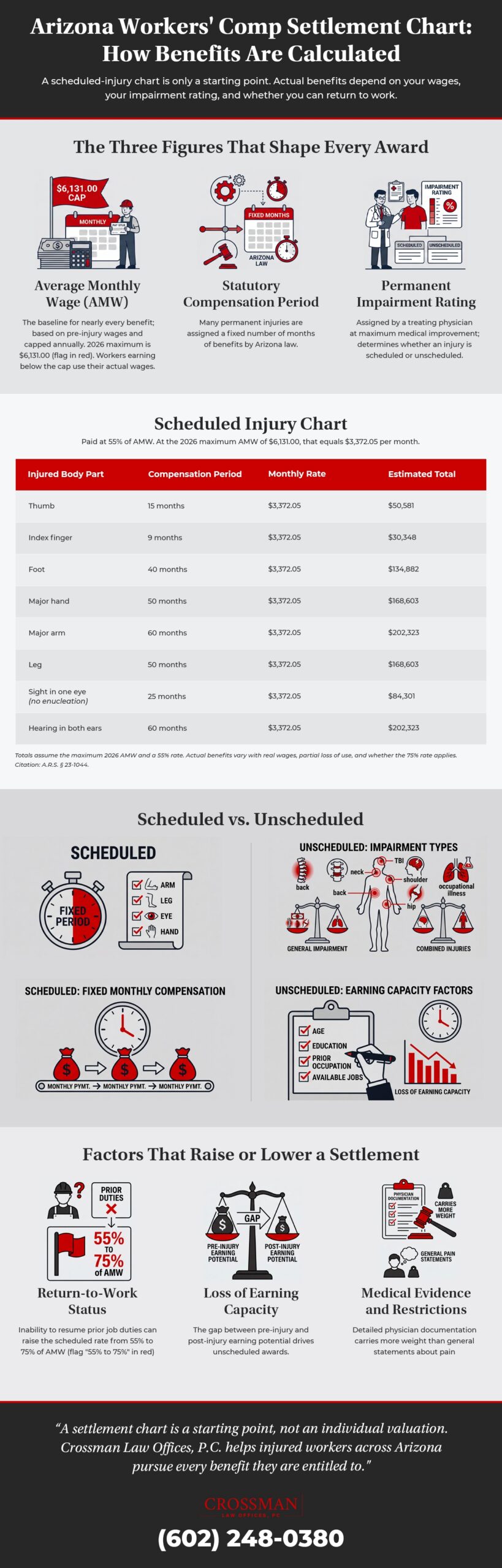
Three figures shape nearly every Arizona workers’ compensation award: the injured worker’s average monthly wage, the statutory compensation period tied to the injury, and the impairment rating a doctor assigns once treatment stabilizes. Each factor interacts with the others, which is why two workers with similar injuries can receive very different benefit amounts.
Average Monthly Wage (AMW)
Average monthly wage sets the baseline for almost every benefit calculation in an Arizona claim. The state calculates it based on wages earned before the injury and caps it at a statutory maximum that adjusts annually.
For injuries occurring in 2026, the Industrial Commission of Arizona puts the maximum at $6,131.00, even for workers who earned more. A worker whose actual wages fall below the cap uses their real earnings instead, so the AMW figure for a claim depends entirely on their individual wage history. For example, a worker earning less than the cap before the injury will have benefits calculated based on their actual wages rather than the statutory maximum, which is why two workers injured in the same accident can end up with different monthly benefit amounts even under the same AMW formula.
Scheduled Compensation Periods
Once an injury qualifies as permanent, Arizona law assigns many of them a fixed number of months of compensation rather than leaving the duration open-ended. These scheduled injuries can include the loss or loss of use of specific body parts, and Arizona workers’ compensation law sets the exact period for each. The compensation rate typically equals 55 percent of the worker’s AMW, paid monthly for the assigned period. Workers unable to return to their prior job duties due to the injury may qualify for a higher rate under the same law.
Permanent Impairment Ratings and Work Restrictions
A treating physician assigns the impairment rating once a worker reaches maximum medical improvement, meaning further treatment is unlikely to produce additional recovery. That rating, combined with any work restrictions the doctor documents, determines whether an injury falls into the scheduled or unscheduled category.
Minor restrictions on lifting or repetitive motion can still result in significant compensation if they prevent a return to the worker’s previous occupation. Insurers sometimes challenge the timing of that determination, arguing a worker reached maximum medical improvement earlier than the treating physician believes, which can shorten the compensation period or lower the assigned rating before an appeal corrects it.
Contact a Workers’ Compensation Lawyer Near You
 Call Us 602-248-0380
Arizona Workers’ Comp Settlement Chart for Scheduled Injuries
Scheduled injuries are the closest thing Arizona law offers to an actual workers’ comp settlement chart, since the statute lists a defined compensation period for each body part. The figures below use the 2026 average monthly wage maximum to illustrate how the calculation works in practice.
Common Scheduled Injuries and Statutory Compensation Periods
The table below functions as a practical workers’ comp payout chart for the most common scheduled injuries our office handles. Under A.R.S. § 23-1044, Arizona sets the following compensation periods, each paid at 55 percent of the worker’s AMW.
Using the 2026 maximum AMW of $6,131.00, that 55 percent rate works out to $3,372.05 per month, the figure reflected in the Monthly Rate column below:
| Injured Body Part | Compensation Period | Monthly Rate (2026 AMW cap) | Estimated Total |
| Thumb | 15 months | $3,372.05 | $50,581 |
| Index finger | 9 months | $3,372.05 | $30,348 |
| Foot | 40 months | $3,372.05 | $134,882 |
| Major hand | 50 months | $3,372.05 | $168,603 |
| Major arm | 60 months | $3,372.05 | $202,323 |
| Leg | 50 months | $3,372.05 | $168,603 |
| Sight in one eye (no enucleation) | 25 months | $3,372.05 | $84,301 |
| Hearing in both ears | 60 months | $3,372.05 | $202,323 |
These totals assume the maximum 2026 AMW and a straightforward 55 percent rate. Actual benefits vary based on the worker’s real average monthly wage, whether the 75 percent rate applies because the worker cannot return to prior job duties, and any partial rather than complete loss of use.
Scheduled vs. Unscheduled Injuries in Arizona
Not every permanent injury fits into a fixed compensation schedule, and the distinction matters more than most injured workers realize. According to the Industrial Commission of Arizona, scheduled injuries affect a specific listed body part, while unscheduled injuries involve a general impairment, a combination of injuries from one incident, or a history of prior permanent impairments.
Why Unscheduled Injuries Do Not Follow a Settlement Chart
Back, shoulder, neck, and hip injuries typically fall into the unscheduled category, along with occupational illnesses and traumatic brain injuries. Rather than a fixed monthly schedule, compensation for these injuries depends on loss of earning capacity, meaning the Industrial Commission compares the worker’s pre-injury wages to what they can realistically earn afterward.
Age, education, prior occupation, and available job opportunities all factor into that determination. Two workers with an identical unscheduled diagnosis can receive very different awards because their earning capacity, not their diagnosis alone, drives the calculation. Vocational experts frequently testify in contested unscheduled claims, comparing the worker’s transferable skills against realistic job openings in the local Arizona labor market to establish what the worker can reasonably still earn. This is the central reason a generic workers’ comp settlement chart cannot account for every Arizona claim.
Factors That Can Increase or Decrease a Workers’ Comp Settlement
Beyond the statutory schedule, several case-specific factors can determine the final settlement amount, often more than the body part involved.
Return-to-Work Status
A worker who returns to the same job at the same pay typically receives a lower unscheduled award than one who cannot return to any comparable work. For scheduled injuries, the inability to resume prior job duties can raise the compensation rate from 55 percent to 75 percent of AMW under the same statute.
Loss of Earning Capacity
For unscheduled claims, the gap between pre-injury and post-injury earning potential can shape the entire calculation. Vocational factors such as transferable skills, local job availability, and physical limitations all influence how the Industrial Commission estimates that gap. Insurance carriers may argue that a worker can perform jobs that do not actually exist in meaningful numbers within commuting distance, an argument that a thorough vocational analysis can effectively rebut.
Medical Evidence and Permanent Restrictions
Thorough documentation from treating physicians usually determines whether an insurer accepts a claimed impairment rating without dispute. Detailed medical records describing specific work restrictions carry more weight than general statements about pain or limited mobility. Photographs, witness statements, and consistent follow-up appointments may all strengthen the medical record supporting a claimed impairment rating when a carrier pushes back.
How a Phoenix Workers’ Compensation Attorney Can Help Maximize Your Recovery
Insurance carriers usually challenge wage calculations, dispute impairment ratings, or argue that a worker can return to more physically demanding jobs than the medical evidence supports. Depending on the case, our attorneys can protect the value of a claim at every stage, including:
- Challenging Wage Calculations: Reviewing wage records and pressing back when an insurer’s numbers do not match the reality of an injury.
- Coordinating Medical Evidence: Working with treating physicians to document impairment ratings and work restrictions accurately.
- Correcting Miscategorized Claims: Identifying when an unscheduled injury has been mistakenly treated as scheduled, or the reverse, since either error can significantly change the benefits a worker receives.
- Managing Deadlines and Filings: Handling the paperwork and deadlines from the first report of injury through any hearing before the Industrial Commission.
With a board-certified specialist Avery Crossman in Phoenix workers’ compensation guiding the case, our team works to ensure every applicable benefit, from AMW calculations to loss of earning capacity, is counted, so injured workers can focus on recovery instead of insurance company tactics.
Contact Crossman Law Offices, P.C.
A workers’ comp settlement chart can offer a starting point, but it cannot replace an accurate, individualized review of your claim. At Crossman Law Offices, P.C., we can help injured workers throughout Arizona understand the value of their claim and pursue every benefit they are entitled to receive. Contact us today at (602) 248-0380 for a consultation.
Avery N Crossman
Ms. Crossman is a Certified Specialist in Workers’ Compensation law by the State Bar of Arizona and past Co-Chair of the State Bar Workers’ Compensation Section. She has served as a faculty member at the State Bar Seminar on Professionalism and as a Judge Pro Tempore in the Maricopa County Superior Court. She is a long-time member of the Arizona Association of Lawyers for Injured Workers and has spoken at Workers’ Compensation seminars sponsored by the organization and the Industrial Commission of Arizona.